
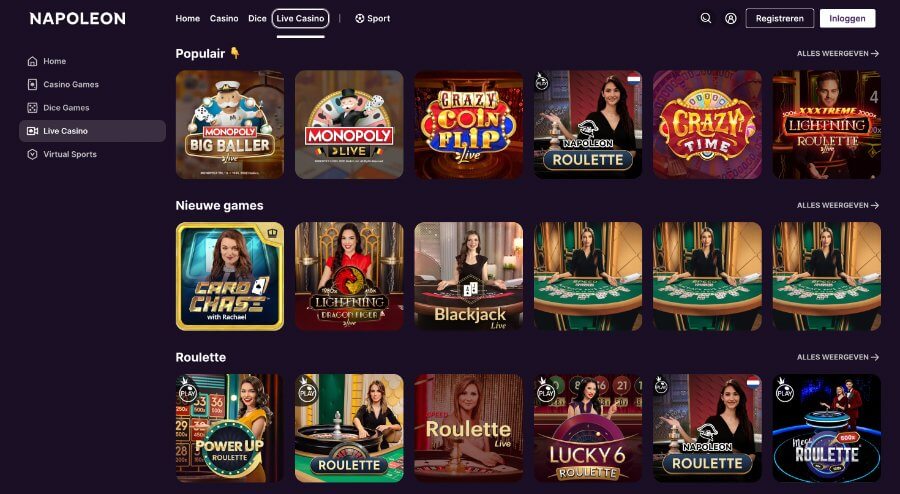
Live dealer games have radically transformed the online gambling landscape, closing the gap between digital convenience and the genuine atmosphere of a brick-and-mortar casino. For Belgian players seeking the thrill of real-time action without leaving home, these games offer a compelling middle ground. Fueled by high-definition streaming technology, professional croupiers manage real cards and spin real wheels from sophisticated studios, while players interact via intuitive digital interfaces. This hybrid experience has soared in popularity, appealing to both seasoned gamblers who miss the social element of land-based venues and newcomers daunted by traditional casino floors. Yet, as with any innovation, live dealer games come with a particular set of advantages and drawbacks. Understanding these nuances is crucial for anyone looking to make informed decisions on platforms like Napoleon Casino, where the live lobby continues to expand with diverse and immersive options.
The Genuine Casino Atmosphere in Your Own Home
The main appeal of live dealer games stems from their uncanny ability to replicate the ambiance of a physical casino. Unlike conventional RNG-based table games that are based on computer graphics and algorithms, live dealer streams feature real felt tables, genuine cards, and the distinct sound of a roulette ball clattering against the wheel. This genuineness is not only cosmetic; it creates a bridge of trust. Watching a human dealer shuffle and deal in real-time delivers a level of transparency that digital simulations struggle to match. For Belgian players who value the refinement of European roulette or the thrill of a blackjack hand, this format brings the seriousness of a Monte Carlo or Knokke casino straight to any screen, keeping the tradition and drama of traditional gambling free from the logistical hurdles of travel or dress codes.
Instant Social Interaction and Community
One of the most overlooked aspects of land-based gambling is the social dynamic, and live dealer games effectively bring this element into the digital realm. A live chat function allows players to communicate directly with the dealer and often with other players at the table. A charismatic croupier can improve the entire session, providing congratulations on a winning hand or commiserating on a near miss, building a rapport that cold software cannot duplicate. This interaction converts solitary screen time into a shared event. For the Belgian audience, where casino culture often includes social outings, this feature preserves a sense of community. It eliminates the isolation of standard online play, promoting a convivial environment where etiquette and banter happen naturally, making the experience feel less like a transaction and more like a night out.
Offers and Deals Specific to Live Games
Historically, online casino bonuses have predominantly favored slot machines, with table games and live dealer titles often accounting a negligible percentage toward wagering requirements. This trend is shifting, but the difference remains a notable con for bonus hunters. Live dealer games carry a lower house edge in many cases, making operators hesitant to expose their margins to bonus abuse. However, savvy platforms now design promotions specifically for the live lobby, such as cashback on net losses during a certain roulette session or leaderboard challenges connected to game show titles. For Belgian players, navigating the terms and conditions is crucial. A welcome offer might look generous, but if live blackjack only contributes 10% to the playthrough, clearing the bonus becomes a marathon rather than a sprint, reducing the perceived value of the promotion.
Mobile Optimization and Multi-Device Play
The technological foundation of real-time casino gaming has been rigorously optimized for smartphone use. Modern HTML5 streams adapt flawlessly to smaller screens, making sure that the interface does not hide the gameplay. Touch controls for placing chips are intuitive, and the portrait mode often gives an optimal detailed view of the dealer and the game table. This mobility means a Belgian player can experience a few games of real-time blackjack during a train trip or while relaxing in a park, provided a steady 4G or 5G connection is available. The convenience of bringing a real-time casino in a handheld device is a monumental advantage over PC-based platforms. The user interface design, which cuts down on clutter while preserving the chat and bet history available, highlights how far the technology has matured to suit the contemporary, traveling routine.
Increased Betting Limits and Limited Accessibility
The cost dynamics of creating a live dealer game are vastly different from operating a server-based digital table. Running a physical studio, employing professional croupiers, and managing high-tech broadcasting equipment generates substantial operational costs. These costs are typically passed down to the player through higher minimum bets. Casual gamblers who partake in micro-stakes digital blackjack may become priced out of the live lobby. Additionally, seating is inherently limited. A studio table only supports a finite number of active players, often seven for blackjack. While many providers provide “Bet Behind” functions that allow infinite viewers to bet on a seated player’s hand, this strips the agency of executing strategic decisions. This blend of higher requirements and reduced direct control can make live games seem exclusive and less available than their unlimited digital counterparts.
Casino Selection and Creative Hybrid Formats
The live dealer sector has developed far beyond classic blackjack, roulette, and baccarat. Modern studios now offer game show hybrids that combine familiar gambling mechanics with the showmanship of television entertainment. Titles like Crazy Time, Monopoly Live, and Dream Catcher include spinning wheels, augmented reality graphics, and lively hosts who steer players through bonus rounds. This innovation infuses a dynamic energy absent from standard table games. For Belgian players searching for novelty, these formats provide a refreshing departure from tradition, merging simple betting rules with high production value. The variety ensures that the live lobby appeals to diverse tastes, from the purist who wants a calm, traditional baccarat table to the thrill-seeker chasing a 500x multiplier on a bright money wheel, all within the same platform ecosystem.
The Variety of Live Experiences
Within a one platform, the scope of experiences can be staggering, split by language, limit, and style. Players can often choose between tables hosted in French, Dutch, or English, which is especially important for a multilingual country like Belgium.
Regional Tables for Belgian Players
Understanding the linguistic diversity of the region, many operators now offer dedicated tables with native-speaking dealers. Playing in one’s mother tongue eliminates communication barriers and enhances the sense of belonging. A Flemish-speaking dealer can make a Dutch-speaking player sense instantly comfortable, while a French table appeals to Walloon sensibilities. This localization is a nuanced yet effective tool that changes a generic international product into a customized local offering, improving comfort and making sure that the social banter in the chat box connects culturally with the participants.
Enhanced Trust and Openness in Gameplay
Skepticism often surrounds the fairness of digital casino games, casino napoleon ouvrir un compte, with players doubting the integrity of Random Number Generators. Live dealer games eliminate this skepticism by putting the action in plain sight. There is no hidden algorithm determining the next card; a physical shoe deals it, and the result is apparent the moment it takes place. This visual confirmation is cognitively powerful, delivering a sense of security that purely digital games cannot provide. Players can observe the dealer’s every move, ensuring no sleight of hand happens. For a particular Belgian market that appreciates regulation and fair play, this transparency is a key selling point. Knowing that the outcome hinges on physical reality rather than a software loop creates a foundational trust that encourages longer, more comfortable playing sessions on trusted platforms like Napoleon Casino.
The reduced tempo and technical shortcomings
Nonetheless, the personal touch that makes these games so genuine also introduces a significant drawback: a noticeably slower pace. A live dealer must personally shuffle, deal, and settle bets, operations that are immediate in digital games. For players who prefer high-volume wagering or fast-paced rounds, this rhythm can appear sluggish. Moreover, the reliance on high-quality streaming introduces technical weaknesses. A weak internet connection can lead to buffering, pixelation, or complete stream loss, destroying the immersion and possibly disrupting a critical bet. Unlike a software crash that stops a game, a live stream freeze can leave a player in limbo. Belgian players in areas with variable broadband must evaluate this risk, as the refined studio environment means nothing if the video feed cannot maintain a stable, crisp resolution throughout the session.
The Immersion Component Versus Distractions at Home
While a live stream delivers the casino home, it also introduces the home into the casino. The absorbing environment of a studio setting must vie with domestic distractions that a physical casino blocks. A doorbell, a canine bark, or a smartphone ping can break the concentration required for a sophisticated blackjack strategy. In a land-based venue, the design and illumination are crafted to keep focus on the felt; at home, the setting is not optimized for gambling psychology. This twofold reality necessitates a focused mindset. The player must actively curate their space to limit interruptions, or else the top-tier experience of a high-definition stream is undermined by mundane household chaos. The onus of preserving the “zone” transfers fully from the operator to the individual.
Tactical Gaming and the Human Element of Error
From a tactical perspective, live dealer games present a cleaner field for systems like the Martingale or card counting, though the latter is heavily mitigated by continuous shuffling machines in most studios. The slower pace permits careful bankroll management and decision-making without the pressure of a ticking clock. Yet, the human element introduces the possibility of dealer error. A card might be mis-scanned, or a bet might be misread by the optical recognition software. While infrequent and usually corrected by the pit boss, these incidents can disrupt the flow and cause disputes. This differs with the infallible logic of RNG software, which never makes a mechanical mistake. The presence of human fallibility introduces a layer of realism but also a slight, albeit irritating, variable that purely digital games eliminate entirely.
What Lies Ahead of Live Dealer Integration
The direction of live dealer gaming suggests deeper digital fusion, with Virtual Reality (VR) on the horizon. The next evolutionary step aims to dissolve the screen barrier entirely, immersing players inside a fully rendered 3D casino where they can move around, sit at a table, and read the body language of avatars. For now, the synergy between live streams and augmented reality bonus rounds in game shows is the standard-bearer. Belgian players can expect even more customized streams, potentially with adjustable camera angles and multi-game play on a single screen. The line between online and offline will continue to blur, making the pros and cons a shifting landscape. What remains constant is the human desire for a genuine, social, and transparent gamble, a need that live dealer games are uniquely suited to fulfill in the digital age.